Discover how lean manufacturing in aerospace is evolving from efficiency-driven models to resilience focused recovery-ready supply networks.
Redefining Lean in Aerospace
For decades, aerospace adopted lean manufacturing with a familiar objective: reduce inventory, improve cash flow, and increase efficiency. This was influenced directly or indirectly by Just-in-Time (JIT) models that proved highly effective in automotive and other high-volume industries.
Today, that interpretation of lean is being fundamentally reworked.
Across commercial aviation, defense programs, and MRO operations, leadership teams are confronting a shared reality: delivery reliability and recovery speed now matter more than marginal efficiency gains. Lean is not being abandoned but redefined to reflect the structural constraints of aerospace.
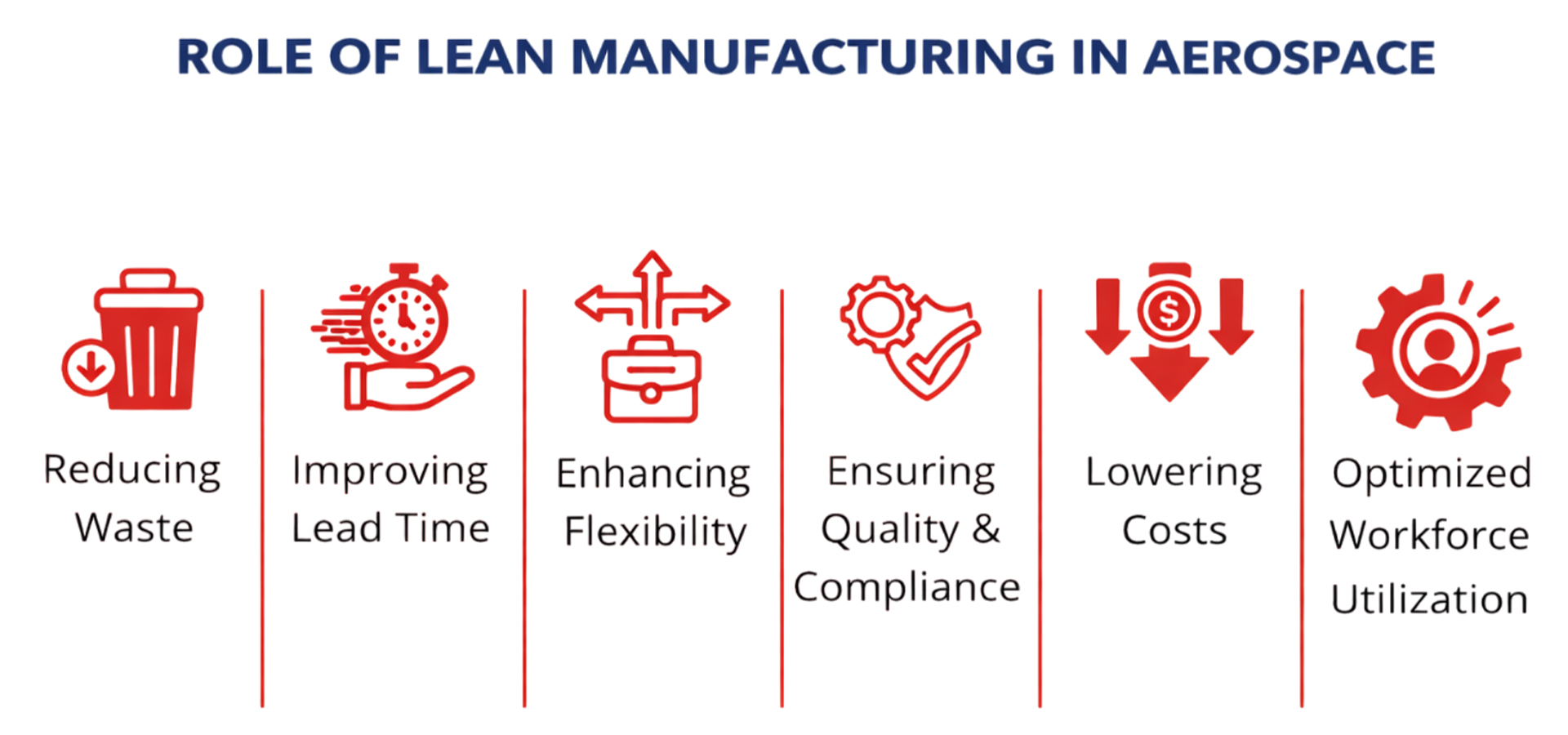
Source: How Boeing’s Lean Manufacturing Strategies Reduce Production Costs and Improve Efficiency?
At the board level, the question has shifted decisively. It is no longer “How lean are we?” It is “How resilient is our supply network?”
Why Just-in-Time Is Incomplete for Aerospace
JIT assumes predictability, stable demand, rapid supplier substitution, and minimal regulatory friction. Aerospace operates under the opposite conditions.
Its supply chains are defined by low-volume, high-complexity production, long certification and qualification cycles, safety-critical components with limited alternates, and deep supplier concentration often beyond tier-1.
Supply-chain risk research cited by McKinsey & Company shows that aerospace has among the longest time-to-recover (TTR) metrics of any industrial sector, 12–18 months for critical components once disruption occurs.
Both Boeing and Airbus have publicly acknowledged that supplier fragility rather than demand has been a primary constraint on production, even amid record order backlogs.
JIT did not fail because it was misapplied. It failed because it assumed stability in a system that is structurally unstable.
Lean Reimagined: From JIT to Resilient Networks
What aerospace is experiencing is not a rejection of lean, but an evolution in how lean is defined and operationalized.
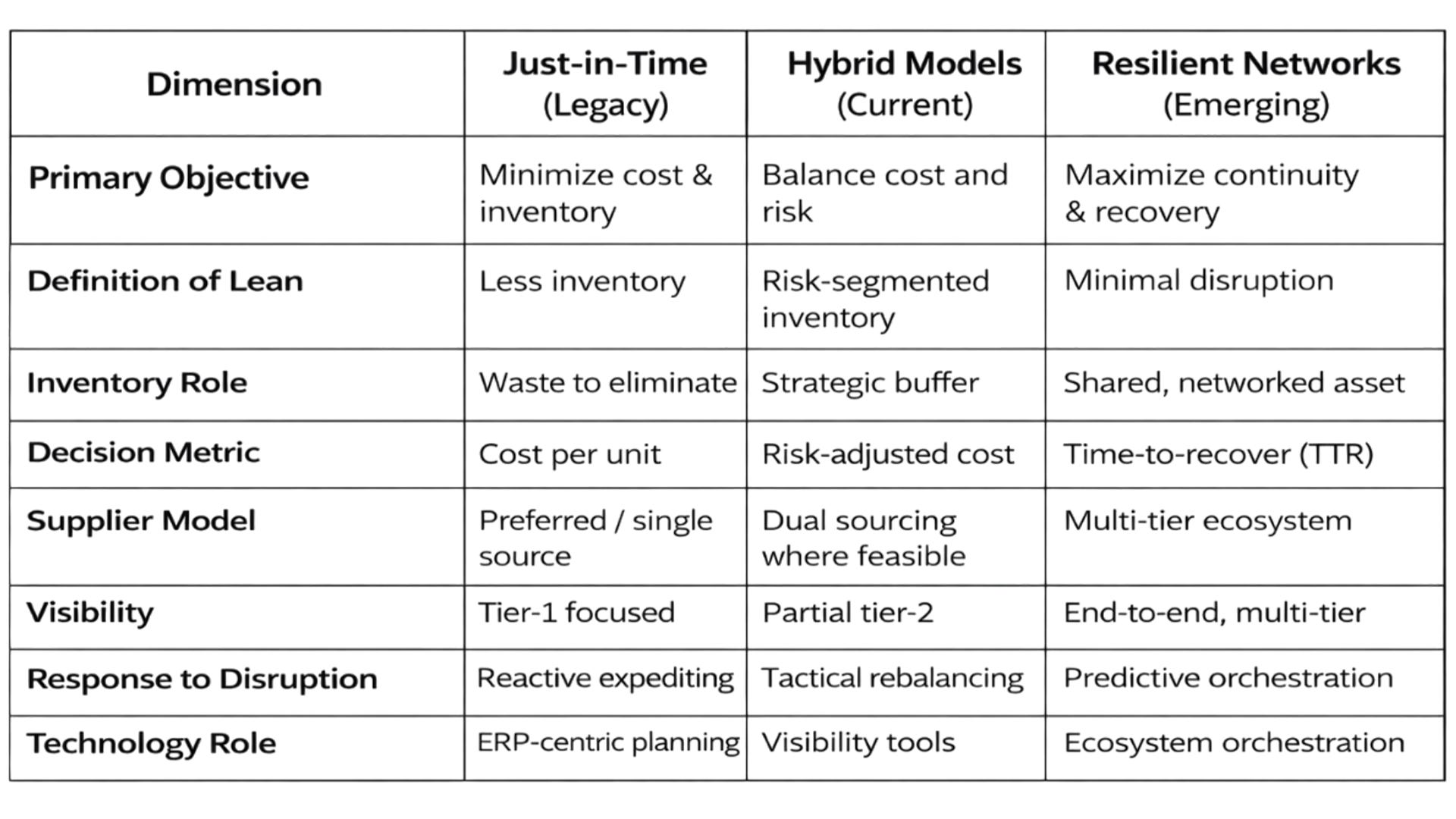
Source: Aerospace Manufacturing Strategies: How to Improve Performance in 2025 & 2026
Across commercial, defense, and MRO environments, the direction is consistent: lean is being redefined around recovery, not reduction.
Why Recovery Speed Outweighs Cost-to-Serve
Analysis by PwC indicates that for aerospace OEMs, a single day of final-assembly disruption can erase the annual savings generated by aggressive inventory-reduction programs.
At the same time, the international Air Transport Association has highlighted that persistent supply-chain bottlenecks continue to drive multi-billion-dollar costs for airlines through extended aircraft ground time, higher maintenance expense, and engine leasing.
For leadership teams, this reframes inventory from a balance-sheet inefficiency into strategic insurance. The performance metric that matters most is no longer cost-to-serve it is time-to-recover.
Why Aerospace Cannot Simply “Lean Faster”
Unlike most industries, aerospace supply chains operate under structural constraints that cannot be optimized away.
These constraints are not organizational inefficiencies, they arise from how safety-critical systems are certified, documented, and sustained over multi-decade lifecycles.
Four interlocking dependencies shape aerospace supply chains:
Certification-driven substitution limits.
Components are tied to specific configurations and approval bases. Substituting suppliers or rerouting parts often triggers requalification, engineering review, and validation cycles measured in months not days.
Deep multi-tier dependencies.
Critical risks often sit beyond tier-1 suppliers, embedded in specialized processes, single-site capabilities, proprietary materials, or skilled labor clusters that are difficult to replicate quickly.
Compliance and traceability as operating requirements.
Traceability of materials, processes, and documentation is not overhead but safety system. Speed without compliance is not agility it is exposure.
Long lifecycle and sustainment obligations.
Aircraft platforms remain in service for decades. Supply chains must support production, upgrades, and long-tail MRO simultaneously, making extreme inventory minimization economically and operationally risky.
The implication is clear: aerospace cannot define lean as speed alone. Lean must be compliant speed.
Technology and the Shift Toward Ecosystem Orchestration
Technology is enabling this redefinition not by eliminating inventory, but by making inventory visible, accessible, and governable across networks.
The most impactful capabilities today focus on:
- Multi-tier supplier visibility
- Inventory discoverability across organizations
- Predictive risk and capacity signals
- Compliance-aware digital workflows
Rather than managing suppliers bilaterally, aerospace leaders are beginning to orchestrate ecosystems connecting OEMs, suppliers, MROs, and inventory holders through shared digital infrastructure.
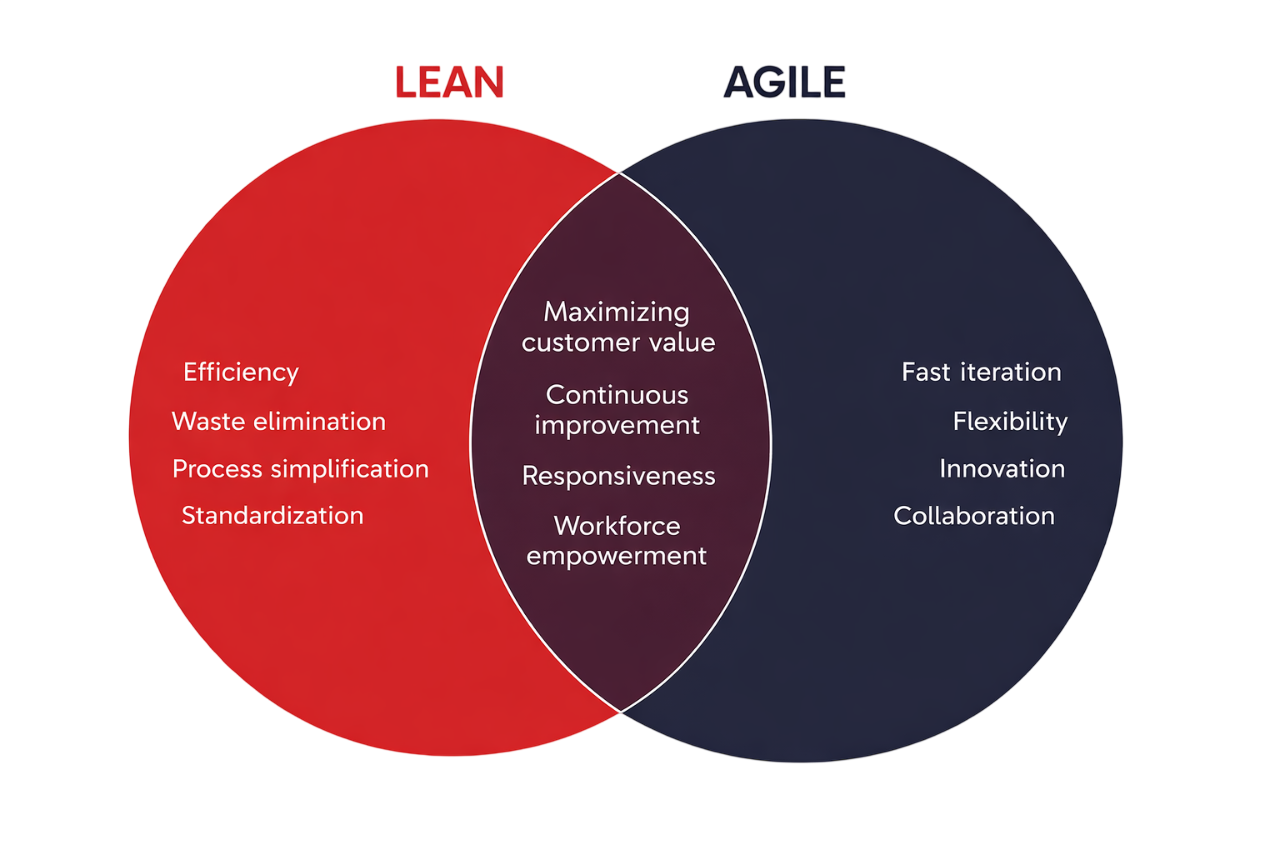
Source: The Evolution of Just in Time and Why It Still Matters Today
The World Economic Forum emphasized that ecosystem-driven digital platforms are essential for resilience in complex, regulated industries. That is what essentially we do at Cnerzy.
Lean as a Network Capability
Lean in aerospace is evolving from an internal efficiency metric into a network-level capability.
Just-in-Time remains a useful tool but no longer a sufficient philosophy. Hybrid models are now standard practice, and resilient supply networks are emerging as the strategic end state across commercial, defense, and MRO segments.
The aerospace leaders of the next decade will not be those with the least inventory.
They will be those who:
- Recover fastest from disruption
- Anticipate risk before it materializes
- Orchestrate compliant ecosystems rather than manage isolated silos
In an industry where safety is absolute and reliability defines reputation resilience has become the new definition of lean.
Source
- McKinsey & Company– Aerospace supply-chain resilience, time-to-recover (TTR), and risk exposure analyses
- PwC– Aerospace operations and supply-chain disruption cost studies
- Deloitte– Aerospace inventory strategy, supplier risk, and operating model benchmarking
- Boston Consulting Group– Resilience vs. efficiency trade-offs and recovery-focused operating models
- International Air Transport Association(IATA) – Airline operations, AOG impact, spare parts inventory, and supply-chain bottlenecks
- Oliver Wyman– Joint IATA–Oliver Wyman analyses on commercial aircraft supply-chain constraints
- Boeing– Public disclosures on production constraints and supplier fragility
- Airbus– Public statements and reports on supply-chain and production challenges
- World Economic Forum– Ecosystem-driven resilience and multi-tier supply-chain visibility in regulated industries